Bernie Devine, Senior Regional Director Asia Pacific, Yardi
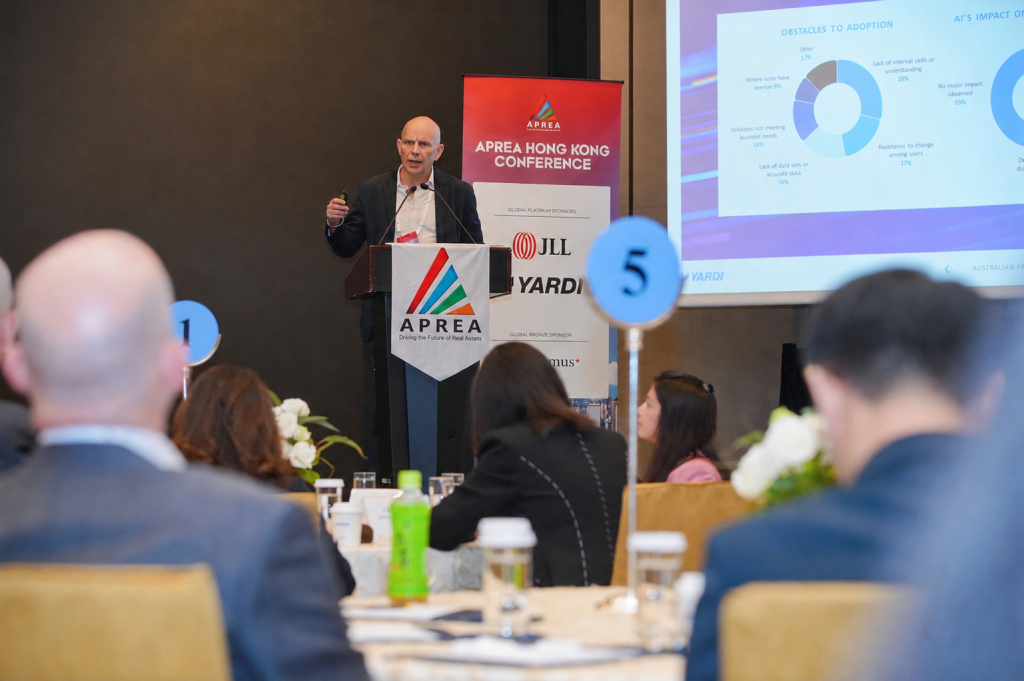
Over the past few months, I’ve attended real estate industry events across Australia and South-East Asia covering everything from capital markets to the future of cities.
One thing has stood out.
Artificial intelligence rarely features on the agenda, but every time someone raises it from the floor, the room comes alive. Questions about tokenisation, compute demand, data centres and energy consumption quickly dominate the discussion.
But curiosity isn’t capability. And one question appears glaringly absent: How will AI change the way real estate businesses actually operate?
Yes, there are pockets of AI innovation around. A handful of companies have deployed AI to solve specific business problems. Most organisations are experimenting with content creation, meeting summaries or analytics. But far fewer have embedded AI into the real business of real estate.
Why is this? I think there are a few reasons.
The first is that most people met AI through a large language model. They learnt to use AI to draft emails, summarise meetings and analyse spreadsheets, and therefore see AI as a personal assistant, not an operational capability (or a colleague).
Leaders ask: “How can AI improve the efficiency of my people?” instead of: “Which parts of my business should AI perform?”
The second reason is that real estate is a workflow business. Property management isn’t one task. It’s thousands of interconnected decisions. A tenant reports a fault. The request is categorised, a contractor is selected and a purchase order is raised. Once the work is completed, the invoice is processed, the payment is authorised and the tenant updated. Most people imagine AI helping with one step. They don’t imagine hiring a digital worker to own that process.
Third, most real estate organisations operate across multiple systems. Leasing, property management, finance, facilities, CRM and document management often sit with different vendors, each holding part of the picture. AI agents are only as effective as the information they can access.
And finally, we’re still buying software the way we always have. We think in terms of modules, not digital workers. Add understandable concerns around governance, accountability and trust, and it’s easy to see why many organisations remain cautious, even if the technology is available.
Yardi’s Virtuoso features an open marketplace where clients and specialist partners are already building AI agents for real estate workflows. Think of it less as an app store and more as a recruitment platform. Organisations can deploy proven agents, adapt them or create entirely new ones without writing code. Virtuoso is already operating in North America and is expected to arrive in Australia and Asia within the next year.
The technology is here whether we’re ready or not. And yet, from my conversations across the region, I can see the chasm between AI hype and AI adoption is still wide.
Closing this chasm is a challenge because deploying AI isn’t a $5 fix. True transformation requires the unglamorous work to modernise data, simplify processes and redesign roles with the understanding that your next recruit is not a person.